Code
data_diabetes %>%
mutate(obese = as.numeric(obese) - 1) %>%
ggplot(aes(y=obese, x=waist)) +
geom_jitter(width=0, height = 0) +
geom_smooth(method="lm", se=FALSE, color=col.blue.dark) +
my.ggtheme
We can think of linear models in machine learning context, as linear models are often used for both building both regression and classification machine learning models and used for predictions It is often the case that some or many of the variables used in a multiple regression model are in fact not associated with the response, and there are feature selection approaches that enable us to exclude irrelevant variables and as a consequence improve prediction results.
Adjusted R-squared (as seen before) \[ R_{adj}^2=1-\frac{RSS}{TSS}\frac{n-1}{n-p-1} = 1 - \frac{\sum_{i=1}^{n}(y_i - \hat{y_i})^2}{\sum_{i=1}^{n}(y_i - \bar{y})^2}\frac{n-1}{n-p-1} \]
AIC and BIC
AIC is grounded in information theory and BIC is derived from a Bayesian point of view. Both are formally defined in likelihood functions. For regression models they can be expressed in terms of RSS because the likelihood of a model in the context of normal errors is directly related to the RSS.
\[\text{AIC} = n \ln(\text{RSS}/n) + 2p\]
where:
\[\text{BIC} = n \ln(\text{RSS}/n) + p \ln(n)\]
where:
Both criteria, AIC and BIC, introduce penalties for the number of parameters to avoid overfitting. BIC introduces a stronger penalty based on the sample size, making it more conservative than AIC. When comparing models using AIC or BIC that incorporate RSS, the objective remains the same: select the model that provides the best balance between goodness of fit and model simplicity. The model with the lower AIC or BIC value is generally preferred, as it indicates either a more parsimonious model or a model that better fits the data (or both).
The smaller the difference between the predicted values vs. the validation or cross-validation predicted values, the better the model.
Feature selection is the process of selecting the most relevant and informative subset of features from a larger set of potential features in order to improve the performance and interpretability of a machine learning model. There are generally three main groups of feature selection methods:
Regularized regression expands on the regression by adding a penalty term or terms to shrink the model coefficients of less important features towards zero. This can help to prevent overfitting and improve the accuracy of the predictive model. Depending on the penalty added, we talk about Ridge, Lasso or Elastic Nets regression.
Previously when talking about regression, we saw that the least squares fitting procedure estimates model coefficients \(\beta_0, \beta_1, \cdots, \beta_p\) using the values that minimize the residual sum of squares: \[RSS = \sum_{i=1}^{n} \left( y_i - \beta_0 - \sum_{j=1}^{p}\beta_jx_{ij} \right)^2 \tag{16.1}\]
In regularized regression the coefficients are estimated by minimizing slightly different quantity. In Ridge regression we estimate \(\hat\beta^{L}\) that minimizes \[\sum_{i=1}^{n} \left( y_i - \beta_0 - \sum_{j=1}^{p}\beta_jx_{ij} \right)^2 + \lambda \sum_{j=1}^{p}\beta_j^2 = RSS + \lambda \sum_{j=1}^{p}\beta_j^2 \tag{16.2}\]
where:
\(\lambda \ge 0\) is a tuning parameter to be determined separately e.g. via cross-validation
Equation 16.2 trades two different criteria:
library(glmnet)
library(latex2exp)

# select subset data
# and scale: since regression puts constraints on the size of the coefficient
data_input <- data_diabetes %>%
  dplyr::select(BMI, chol, hdl, age, stab.glu) %>%
  na.omit()

# fit ridge regression for a series of lambda values
# note: lambda values were chosen by experimenting to show lambda effect on beta coefficient estimates
x <- model.matrix(BMI ~., data = data_input)
y <- data_input %>% pull(BMI)
model <- glmnet(x, y, alpha=0, lambda = seq(0, 100, 1))

# plot beta estimates vs. lambda
betas <- model$beta %>% as.matrix() %>% t()
data_plot <- tibble(data.frame(lambda = model$lambda, betas)) %>%
  dplyr::select(-"X.Intercept.") %>%
  pivot_longer(-lambda, names_to = "variable", values_to = "beta")

data_plot %>%
  ggplot(aes(x = lambda, y = beta, color = variable)) +
  geom_line(linewidth = 2, alpha = 0.7) +
  theme_classic() +
  xlab(TeX("$\\lambda$")) +
  ylab(TeX("Standardized coefficients")) +
  scale_color_brewer(palette = "Set1") +
  theme(legend.title = element_blank(), legend.position = "top", legend.text = element_text(size=12)) +
  theme(axis.title = element_text(size = 12), axis.text = element_text(size = 10))
Ridge regression’s advantages over least squares estimates stems from bias-variance trade-off, another fundamental concept in machine learning.
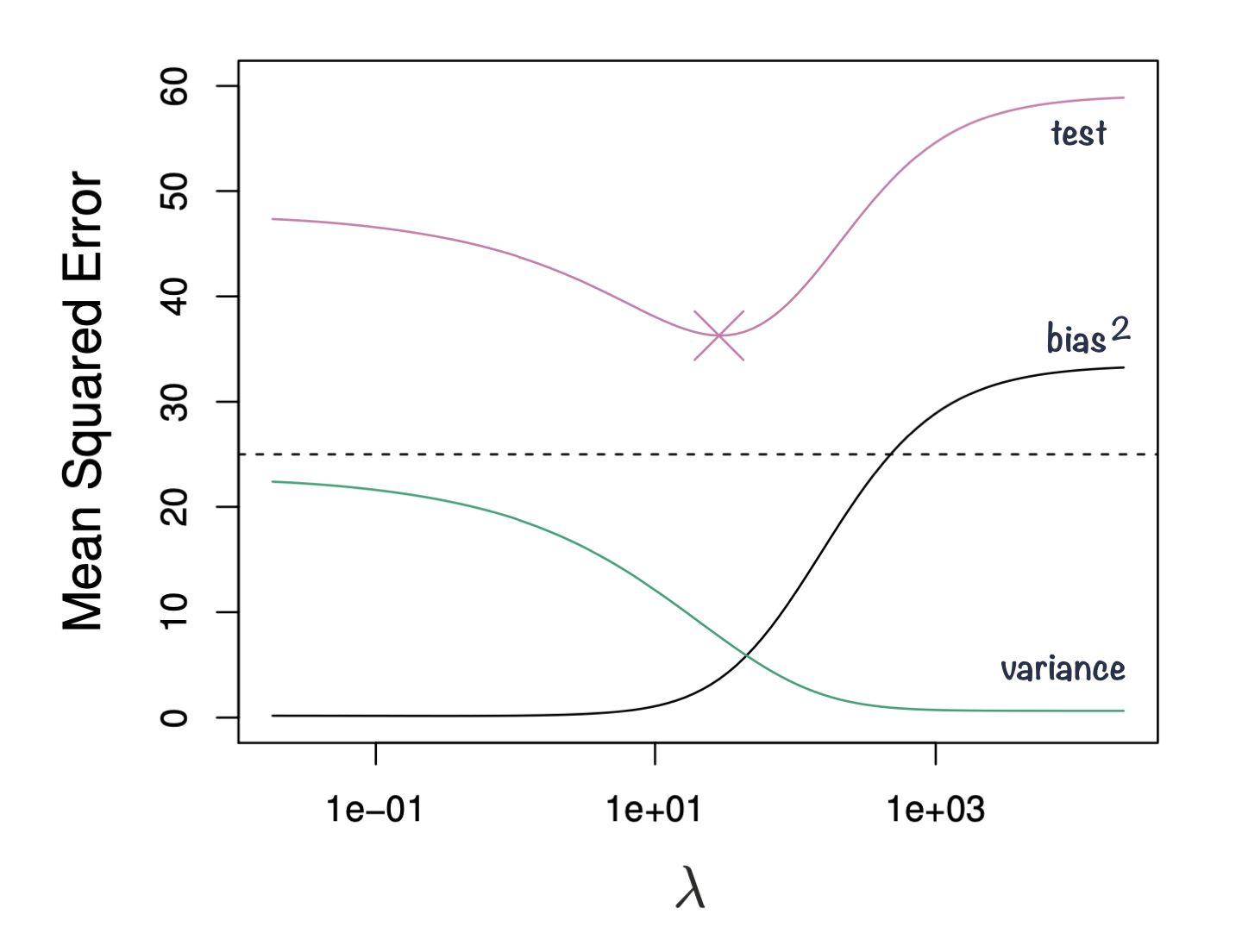
In Ridge regression we minimize: \[\sum_{i=1}^{n} \left( y_i - \beta_0 - \sum_{j=1}^{p}\beta_jx_{ij} \right)^2 + \lambda \sum_{j=1}^{p}\beta_j^2 = RSS + \lambda \sum_{j=1}^{p}\beta_j^2 \tag{16.3}\] where \(\lambda \sum_{j=1}^{p}\beta_j^2\) is also known as L2 regularization element or \(l_2\) penalty
In Lasso regression, that is Least Absolute Shrinkage and Selection Operator regression we change penalty term to absolute value of the regression coefficients: \[\sum_{i=1}^{n} \left( y_i - \beta_0 - \sum_{j=1}^{p}\beta_jx_{ij} \right)^2 + \lambda \sum_{j=1}^{p}|\beta_j| = RSS + \lambda \sum_{j=1}^{p}|\beta_j| \tag{16.4}\] where \(\lambda \sum_{j=1}^{p}|\beta_j|\) is also known as L1 regularization element or \(l_1\) penalty
Lasso regression was introduced to help model interpretation. With Ridge regression we improve model performance but unless \(\lambda = \infty\) all beta coefficients are non-zero, hence all variables remain in the model. By using \(l_1\) penalty we can force some of the coefficients estimates to be exactly equal to 0, hence perform variable selection
library(glmnet)
library(latex2exp)

# select subset data
# and scale: since regression puts constraints on the size of the coefficient
data_input <- data_diabetes %>%
  dplyr::select(BMI, chol, hdl, age, stab.glu) %>%
  na.omit()

# fit ridge regression for a series of lambda values
# note: lambda values were chosen by experimenting to show lambda effect on beta coefficient estimates
x <- model.matrix(BMI ~., data = data_input)
y <- data_input %>% pull(BMI)
model <- glmnet(x, y, alpha=1, lambda = seq(0, 2, 0.1))

# plot beta estimates vs. lambda
betas <- model$beta %>% as.matrix() %>% t()
data_plot <- tibble(data.frame(lambda = model$lambda, betas)) %>%
  dplyr::select(-"X.Intercept.") %>%
  pivot_longer(-lambda, names_to = "variable", values_to = "beta")

data_plot %>%
  ggplot(aes(x = lambda, y = beta, color = variable)) +
  geom_line(linewidth = 2, alpha = 0.7) +
  theme_classic() +
  xlab(TeX("$\\lambda$")) +
  ylab(TeX("Standardized coefficients")) +
  scale_color_brewer(palette = "Set1") +
  theme(legend.title = element_blank(), legend.position = "top", legend.text = element_text(size=12)) +
  theme(axis.title = element_text(size = 12), axis.text = element_text(size = 10))
Elastic Net use both L1 and L2 penalties to try to find middle grounds by performing parameter shrinkage and variable selection. \[\sum_{i=1}^{n} \left( y_i - \beta_0 - \sum_{j=1}^{p}\beta_jx_{ij} \right)^2 + \lambda \sum_{j=1}^{p}|\beta_j| + \lambda \sum_{j=1}^{p}\beta_j^2 = RSS + \lambda \sum_{j=1}^{p}|\beta_j| + \lambda \sum_{j=1}^{p}\beta_j^2 \tag{16.5}\]
In the glmnet library we can fit Elastic Net by setting parameters \(\alpha\). Actually, under the hood glmnet minimizes a cost function: \[\sum_{i_=1}^{n}(y_i-\hat y_i)^2 + \lambda \left ( (1-\alpha) \sum_{j=1}^{p}\beta_j^2 + \alpha \sum_{j=1}^{p}|\beta_j|\right )\] where:
When \(\alpha = 0\) this corresponds to Ridge regression and when \(\alpha=1\) this corresponds to Lasso regression. A value of \(0 < \alpha < 1\) gives us Elastic Net regularization, combining both L1 and L2 regularization terms.
library(glmnet)
library(latex2exp)

# select subset data
# and scale: since regression puts constraints on the size of the coefficient
data_input <- data_diabetes %>%
  dplyr::select(BMI, chol, hdl, age, stab.glu) %>%
  na.omit()

# fit ridge regression for a series of lambda values
# note: lambda values were chosen by experimenting to show lambda effect on beta coefficient estimates
x <- model.matrix(BMI ~., data = data_input)
y <- data_input %>% pull(BMI)
model <- glmnet(x, y, alpha=0.1, lambda = seq(0, 3, 0.05))

# plot beta estimates vs. lambda
betas <- model$beta %>% as.matrix() %>% t()
data_plot <- tibble(data.frame(lambda = model$lambda, betas)) %>%
  dplyr::select(-"X.Intercept.") %>%
  pivot_longer(-lambda, names_to = "variable", values_to = "beta")

data_plot %>%
  ggplot(aes(x = lambda, y = beta, color = variable)) +
  geom_line(linewidth = 2, alpha = 0.7) +
  theme_classic() +
  xlab(TeX("$\\lambda$")) +
  ylab(TeX("Standardized coefficients")) +
  scale_color_brewer(palette = "Set1") +
  theme(legend.title = element_blank(), legend.position = "top", legend.text = element_text(size=12)) +
  theme(axis.title = element_text(size = 12), axis.text = element_text(size = 10))
data_diabetes %>%
  mutate(obese = as.numeric(obese) - 1) %>%
  ggplot(aes(y=obese, x=waist)) +
  geom_jitter(width=0, height = 0) +
  geom_smooth(method="lm", se=FALSE, color=col.blue.dark) +
my.ggthemeLet’s look again at the binary obesity status data and try to fit logistic regression model using waist as explanatory variable instead of fitting inappropriate here simple linear model.
p1 <- data_diabetes %>%
  mutate(obese = as.numeric(obese) - 1) %>%
  ggplot(aes(y=obese, x=waist)) +
  geom_jitter(width=0, height = 0.05, alpha = 0.7) +
  my.ggtheme

p2 <- data_diabetes %>%
  ggplot(aes(x = obese, y = waist, fill = obese)) +
  geom_boxplot() +
  scale_fill_brewer(palette = "Set2") +
  my.ggtheme

grid.arrange(p1, p2, ncol = 2)
g() is the link function.In R we can use glm() function to fit GLM models:
# re-code obese status from Yes/No to 1/0
data_diabetes <-
  data_diabetes %>%
  mutate(obese = as.numeric(obese) - 1)

# fit logistic regression model
logmodel_1 <- glm(obese ~ waist, family = binomial(link="logit"), data = data_diabetes)

# print model summary
print(summary(logmodel_1))
##
## Call:
## glm(formula = obese ~ waist, family = binomial(link = "logit"),
##     data = data_diabetes)
##
## Coefficients:
##             Estimate Std. Error z value Pr(>|z|)
## (Intercept)  -17.357      2.973  -5.837 5.30e-09 ***
## waist         17.174      2.974   5.775 7.71e-09 ***
## ---
## Signif. codes:  0 '***' 0.001 '**' 0.01 '*' 0.05 '.' 0.1 ' ' 1
##
## (Dispersion parameter for binomial family taken to be 1)
##
##     Null deviance: 178.71  on 129  degrees of freedom
## Residual deviance: 102.79  on 128  degrees of freedom
## AIC: 106.79
##
## Number of Fisher Scoring iterations: 5

# plot
ggPredict(logmodel_1) +
  my.ggtheme
# to get predictions use predict() functions
# if no new observations is specified predictions are returned for the values of exploratory variables used
# we specify response to return prediction on the probability scale
obese_predicted <- predict(logmodel_1, type="response")
print(head(obese_predicted))
##          3          7          9         11         16         21
## 0.98231495 0.93752915 0.07405337 0.41460606 0.22839680 0.72385967In our example, we can check whether waist is associated with obesity status by testing null hypothesis: \(H_0:\beta_1=0\). We calculate Wald statistics as \(W^2 = \frac{(\hat\beta-0)}{\hat {e.s.e}(\hat\beta)} = \frac{17.174}{2.974} = 5.774714\) and we can find the corresponding p-value using standard normal distribution:
2*pnorm(5.774714, lower.tail = F)
## [1] 7.70839e-09
which confirms the summary output shown previously above and shows that there is enough evidence to reject the null hypothesis at 5% significance level \(p-value << 0.05\) and conclude that there is a significant association between waist and obesity status.
For instance, given our model we have null deviance of 274.4 and residual deviance of 268.7. The difference 5.7 is larger than than 95th percentile of \(\chi^2(129-128)\) = 3.841459, where 129 is degrees of freedom for null model and 128 is degrees of freedom for null model excluding the waist explanatory variable.
qchisq(df=1, p=0.95)
## [1] 3.841459waist is a significant term in the model.waist the odds of suffering from obesity get multiplied by 28745736.These odds ratios are very high as here we are modeling obesity status with waist measurements, and increasing one unit in waist would mean adding up additional 1m to waist measurements. Typically:
# fit logistic regression including age and gender
logmodel_2 <- glm(obese ~ waist + gender, family = binomial(link="logit"), data = data_diabetes)

# print model summary
print(summary(logmodel_2))
##
## Call:
## glm(formula = obese ~ waist + gender, family = binomial(link = "logit"),
##     data = data_diabetes)
##
## Coefficients:
##              Estimate Std. Error z value Pr(>|z|)
## (Intercept)  -18.2756     3.1077  -5.881 4.08e-09 ***
## waist         17.4401     3.0523   5.714 1.11e-08 ***
## genderfemale   1.2335     0.5228   2.359   0.0183 *
## ---
## Signif. codes:  0 '***' 0.001 '**' 0.01 '*' 0.05 '.' 0.1 ' ' 1
##
## (Dispersion parameter for binomial family taken to be 1)
##
##     Null deviance: 178.708  on 129  degrees of freedom
## Residual deviance:  96.877  on 127  degrees of freedom
## AIC: 102.88
##
## Number of Fisher Scoring iterations: 6

# plot model
ggPredict(logmodel_2) +
  my.ggtheme +
  scale_color_brewer(palette = "Set2")
Example 16.1 (Number of cancer cases) Suppose we wish to model \(Y_i\) the number of cancer cases in the i-th intermediate geographical location (IG) in Glasgow. We have collected data for 271 small regions with between 2500 and 6000 people living in them. Together with cancer occurrence with have the following data:
We can model the rate of occurrence of cancer using the very same glm function:¨ - now we use poisson family distribution to model counts - and we will include an offset term to the model as we are modeling the rate of occurrence of the cancer that has to be adjusted by different number of people living in different regions.
# Read in and preview data
cancer <- read.csv("data/lm/cancer.csv")
head(cancer)
##          IG Y_all     E_all pm10 smoke ethnic log.price  easting northing
## 1 S02000260   133 106.17907 17.8  21.9   5.58  11.59910 26.16245 66.96574
## 2 S02000261    38  62.43131 18.6  21.8   7.91  11.84940 26.29271 67.00278
## 3 S02000262    97 120.00694 18.6  20.8   9.58  11.74106 26.21429 67.04280
## 4 S02000263    80 109.10245 17.0  14.0  10.39  12.30138 25.45705 67.05938
## 5 S02000264   181 149.77821 18.6  15.2   5.67  11.88449 26.12484 67.09280
## 6 S02000265    77  82.31156 17.0  14.6   5.61  11.82004 25.37644 67.09826

# fit Poisson regression
epid1 <- glm(Y_all ~ pm10 + smoke + ethnic + log.price + easting + northing + offset(log(E_all)),
             family = poisson,
             data = cancer)

print(summary(epid1))
##
## Call:
## glm(formula = Y_all ~ pm10 + smoke + ethnic + log.price + easting +
##     northing + offset(log(E_all)), family = poisson, data = cancer)
##
## Coefficients:
##               Estimate Std. Error z value Pr(>|z|)
## (Intercept) -0.8592657  0.8029040  -1.070 0.284531
## pm10         0.0500269  0.0066724   7.498 6.50e-14 ***
## smoke        0.0033516  0.0009463   3.542 0.000397 ***
## ethnic      -0.0049388  0.0006354  -7.773 7.66e-15 ***
## log.price   -0.1034461  0.0169943  -6.087 1.15e-09 ***
## easting     -0.0331305  0.0103698  -3.195 0.001399 **
## northing     0.0300213  0.0111013   2.704 0.006845 **
## ---
## Signif. codes:  0 '***' 0.001 '**' 0.01 '*' 0.05 '.' 0.1 ' ' 1
##
## (Dispersion parameter for poisson family taken to be 1)
##
##     Null deviance: 972.94  on 270  degrees of freedom
## Residual deviance: 565.18  on 264  degrees of freedom
## AIC: 2356.2
##
## Number of Fisher Scoring iterations: 4
Rate ratio
\[ \left( \sum_{i=1}^n [y_i \log(p_i) + (1-y_i) \log(1-p_i)] \right) + \lambda \sum_{j=1}^p |\beta_j| \]
where: