Recurrent neural networks
06-May-2026
Perceptron (single neuron)
Architecture
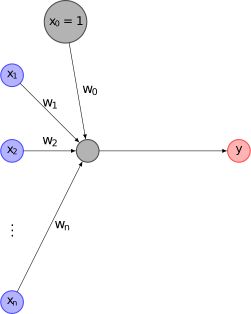
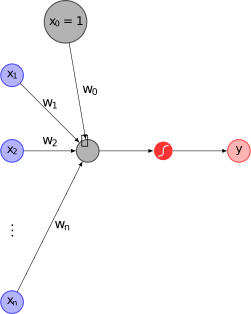
A single neuron has n inputs x_i and an output y. To each input is associated a weight w_i.
Activity rule
The activity rule is given by two steps:
a = \sum_{i} w_ix_i, \quad i=0,...,n
\begin{array}{ccc} \mathrm{activation} & & \mathrm{activity}\\ a & \rightarrow & y(a) \end{array}
Perceptron (single neuron)
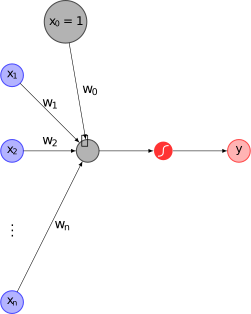
a = w_0 + \sum_{i} w_ix_i, \quad i=1,...,n
y = y(a) = g\left( w_0 + \sum_{i=1}^{n} w_ix_i \right)
or in vector notation
y = g\left(w_0 + \mathbf{X^T} \mathbf{W} \right)
where:
\quad\mathbf{X}= \begin{bmatrix}x_1\\ \vdots \\ x_n\end{bmatrix}, \quad \mathbf{W}=\begin{bmatrix}w_1\\ \vdots \\ w_n\end{bmatrix}
Simplified illustration and notation

Architecture
Vectorized versions: input \boldsymbol{x}, weights \boldsymbol{w}, output \boldsymbol{y}
Activity rule
a = \boldsymbol{wx}
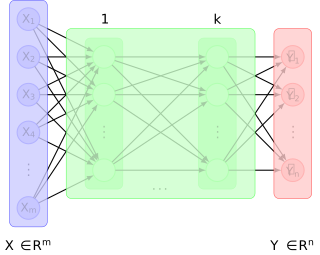
Feed forward network
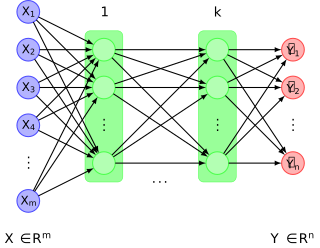
Feed forward network
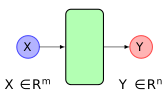
Simplified illustration
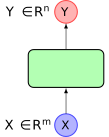
Simplified illustration
Motivation

Motivation

Motivation

Motivation

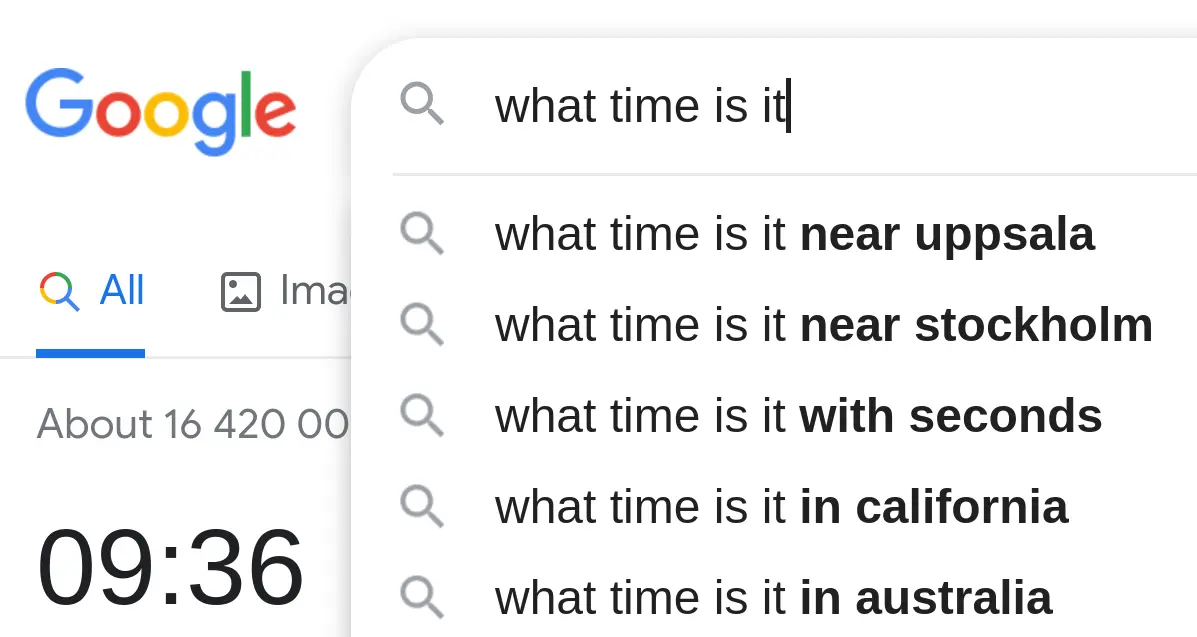
Sequences around us


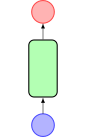
Types of models
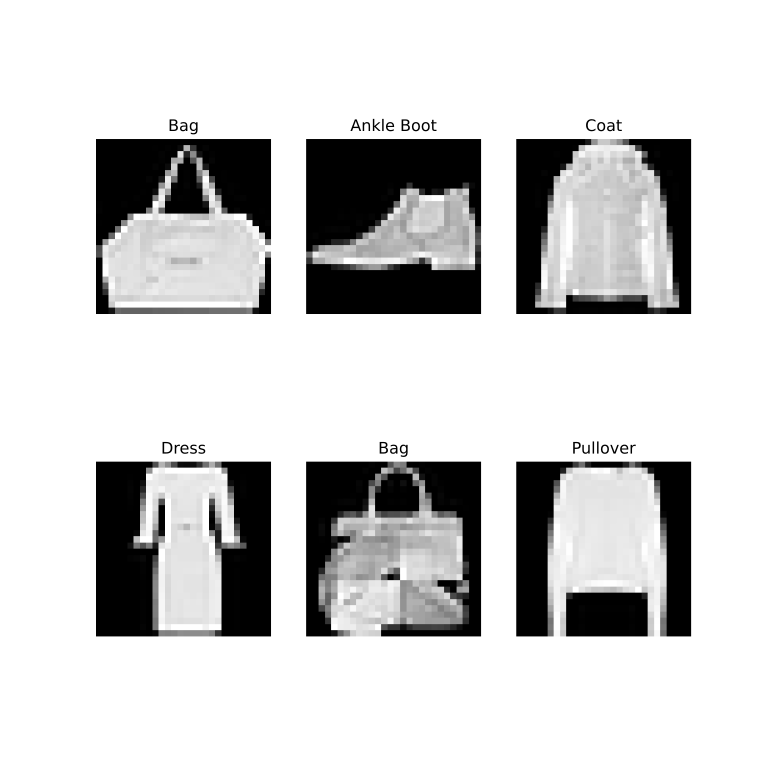
one to one (fixed input/output)
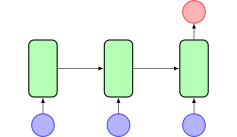
many to one
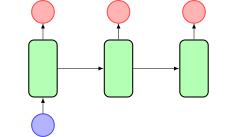
one to many
many to many
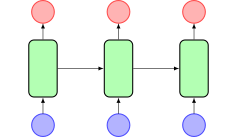
Image classification
Sentiment analysis

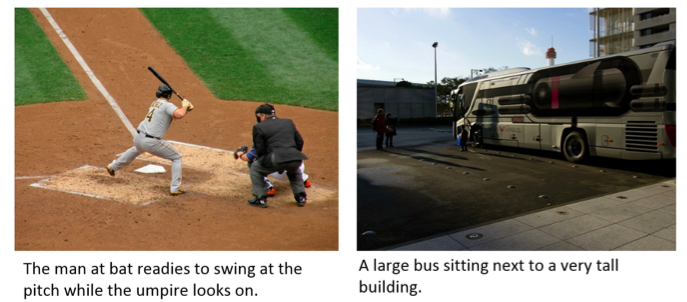
Image captioning
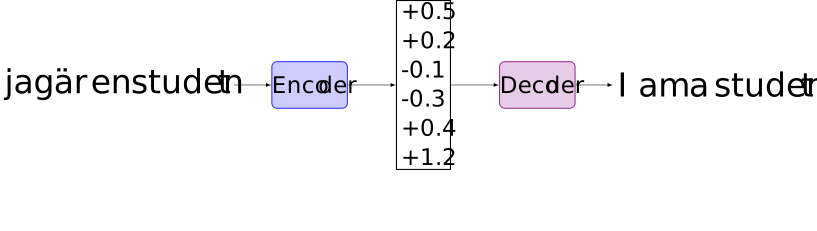
Machine translation

Recurrent Neural Networks (RNNs)
Feed forward network implementation to sequential data
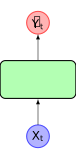
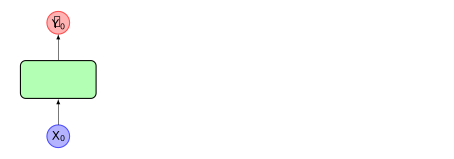
Assume multiple time points.
Feed forward network implementation to sequential data
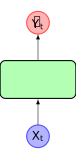
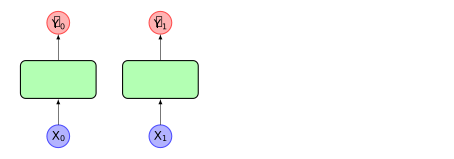
Assume multiple time points.
Feed forward network implementation to sequential data
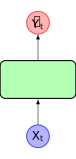
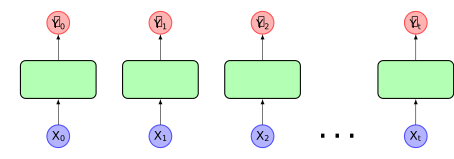
Assume multiple time points.
- Dependency of inputs not modelled \Rightarrow ambiguous sequences cannot be distinguished:
“dog bites man” vs “man bites dog”
Feed forward network implementation to sequential data
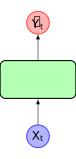
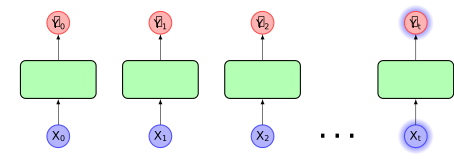
Assume multiple time points.
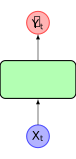
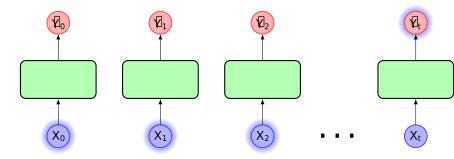
- Time points are modelled individually (\hat{Y}_t = f(X_t))
Feed forward network implementation to sequential data
Assume multiple time points.
- Time points are modelled individually (\hat{Y}_t = f(X_t))
- However: also want dependency on previous inputs (\hat{Y}_t = f(..., X_1, X_0))
Adding recurrence relations
Adding recurrence relations
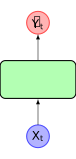
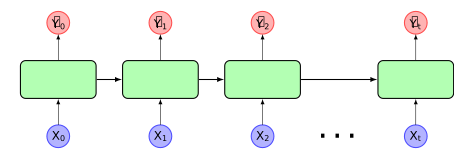
Adding recurrence relations
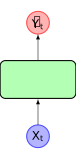
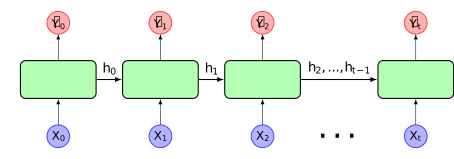
Adding recurrence relations
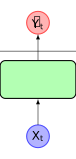
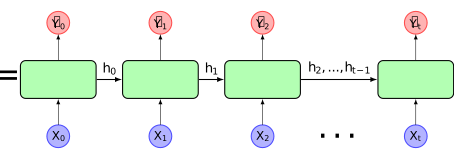
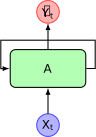
Folded representation
Unfolded representation
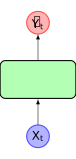
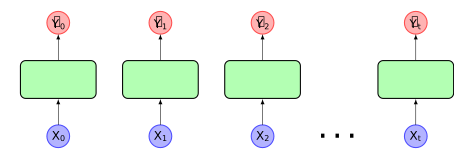
Add a hidden state h that introduces a dependency on the previous step:
\hat{Y}_t = f(X_t, h_{t-1})
h_t is a summary of the inputs we’ve seen sofar.
Recurrent Neural Networks
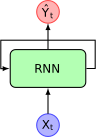
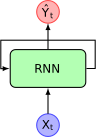
Add recurrence relation where current hidden cell state h_t depends on input x_t and previous hidden state h_{t-1} via a function f_W that defines the network parameters (weights):
h_t = f_\mathbf{W}(x_t, h_{t-1})
Note that the same function and weights are used across all time steps!
Recurrent Neural Networks - pseudocode
class RNN:
  # ...
  # Description of forward pass
  def forward(self, x):
    # update the hidden state
    self.h = np.tanh(np.dot(self.W_hh, self.h) + np.dot(self.W_xh, x))
    # compute the output vector
    y = np.dot(self.W_hy, self.h)
    return y

rnn = RNN()
ff = FeedForwardNN()

for word in input:
    output = rnn.forward(word)

prediction = ff(output)
Vanilla RNNs
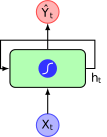
Output vector
\hat{Y}_t = \mathbf{W_{hy}^T}h_t
Update hidden state
h_t = \mathsf{tanh}(\mathbf{W_{xh}^T}X_t + \mathbf{W_{hh}^T}h_{t-1})
Input vector
X_t
Vanilla RNNs
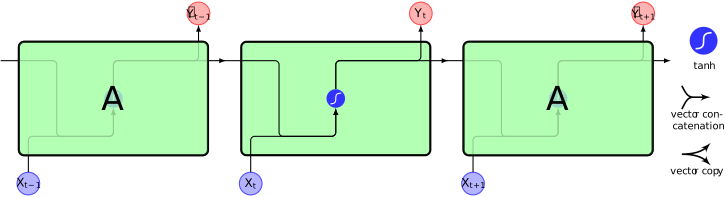
Vanilla RNNs
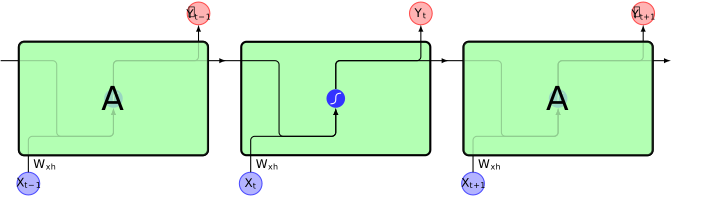
Vanilla RNNs
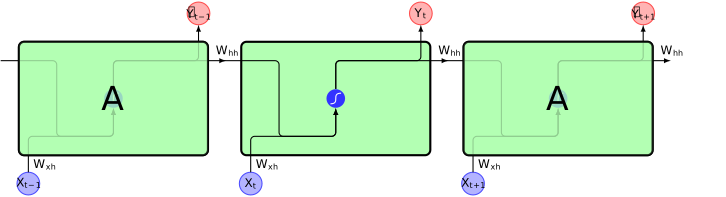
Vanilla RNNs
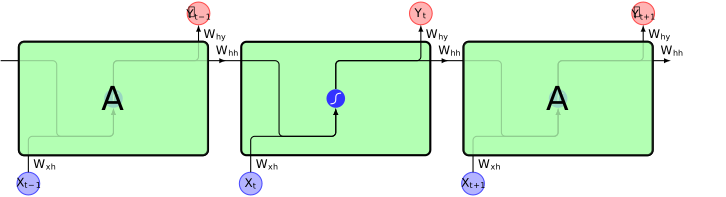
Note: \mathbf{W_{xh}}, \mathbf{W_{hh}}, and \mathbf{W_{hy}} are shared across all cells!
Box & Jenkins airline passenger data set
import pandas as pd
df = pd.read_csv(
    'airline-passengers.csv',
    names=['time','passengers'],
    header=0
)
df['time'] = pd.to_datetime(
    df['time'], format='%Y-%m'
)
df.head(12)
time passengers
0 1949-01-01 112
1 1949-02-01 118
2 1949-03-01 132
3 1949-04-01 129
4 1949-05-01 121
5 1949-06-01 135
6 1949-07-01 148
7 1949-08-01 148
8 1949-09-01 136
9 1949-10-01 119
10 1949-11-01 104
11 1949-12-01 118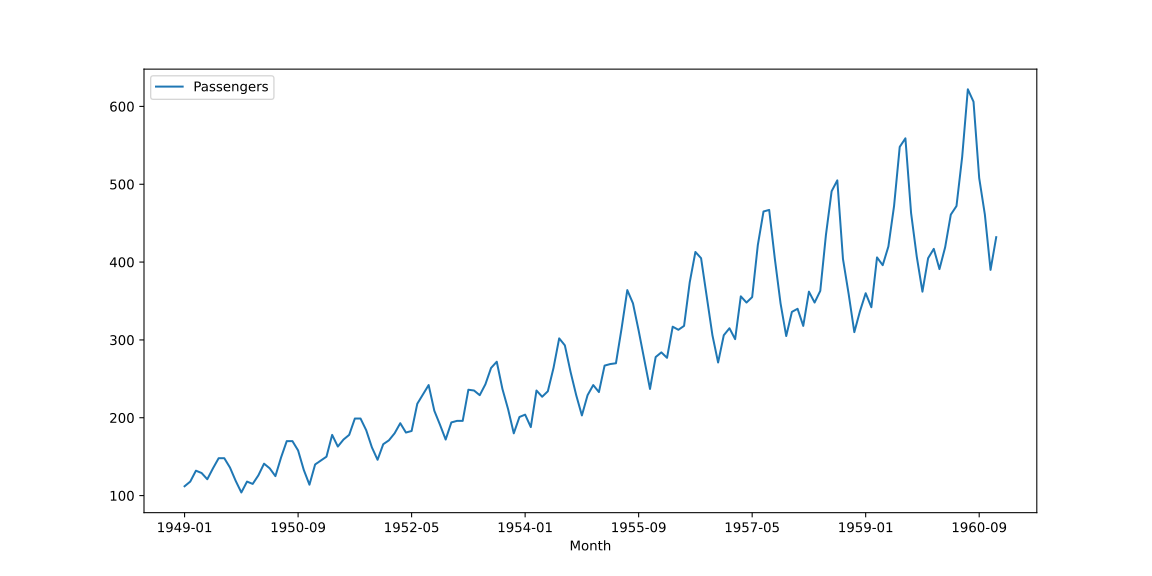
Generate test and training data
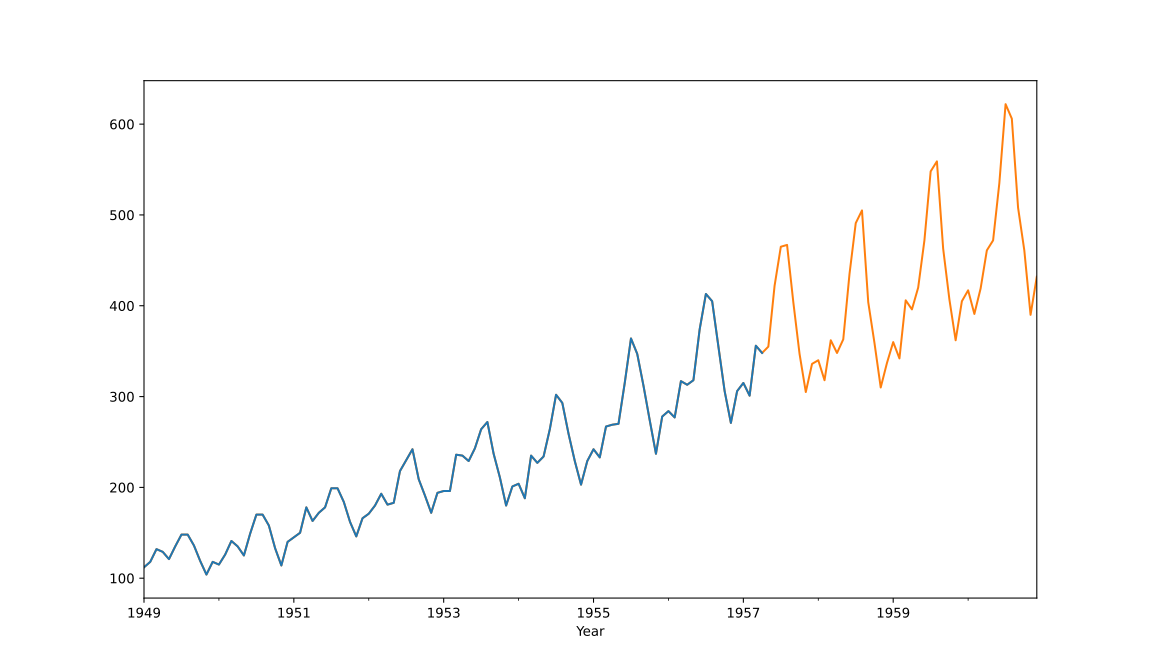
Partition time series into training and test data sets at an e.g. 2:1 ratio
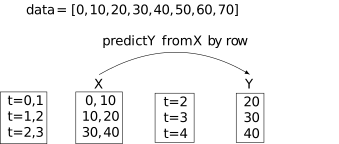
Generate input-output pairs by sliding a window across time points where input (X) corresponds to values in window, output (Y) the value following the last window index
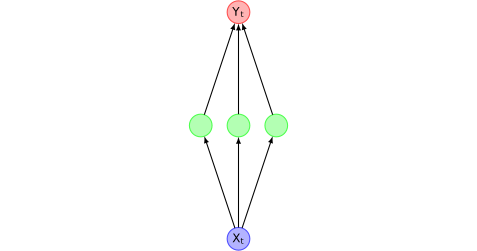
Example: model topology writ out
AirlineRNN(
  (rnn): RNN(1, 3, batch_first=True)
  (fc1): Linear(in_features=3, out_features=1, bias=True)
  (fc2): Linear(in_features=1, out_features=1, bias=True)
)
Example: model topology writ out
AirlineRNN(
  (rnn): RNN(1, 3, batch_first=True)
  (fc1): Linear(in_features=3, out_features=1, bias=True)
  (fc2): Linear(in_features=1, out_features=1, bias=True)
)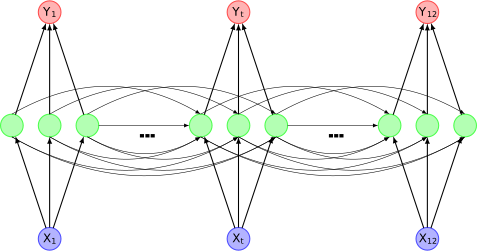
NB! In PyTorch, RNN input is a 3D tensor with shape (seq, batch, feature) by default; set batch_first=True to reshape to (batch, seq, feature). Here, seq = sequence length, batch = batch size, and feature = input_size, the number of expected features in the input x.
An RNN in numbers
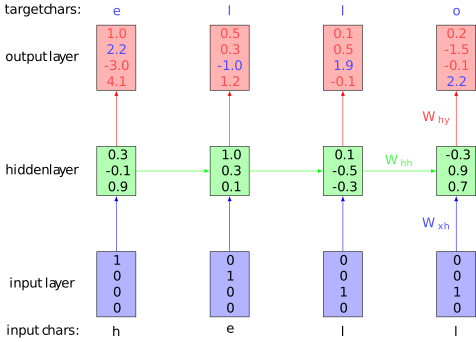
Example network trained on “hello” showing activations in forward pass given input “hell”. The outputs contain confidences in outputs (vocabulary={h, e, l, o}). We want blue numbers high, red numbers low. P(e) is in context of “h”, P(l) in context of “he” and so on.
What is the topology of the network?
4 input units h, e, l, o (features), 4 time steps, 3 hidden units, 4 output units
Exercise
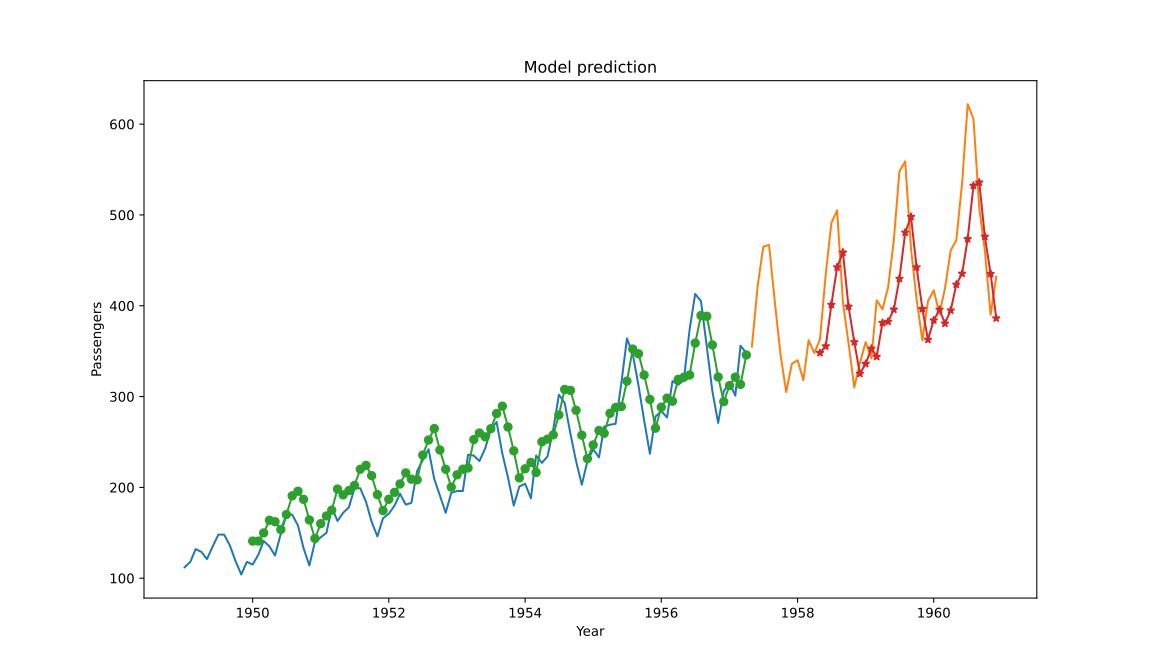
Using the AirlineRNN (Vanilla RNN) class, see if you can improve the airline passenger model. Some things to try:
- change the number of hidden units
- change time_steps
- change the number of epochs
Recap: backpropagation algorithm in ffns
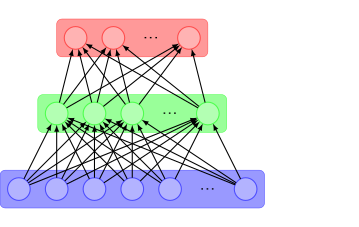
Recap: backpropagation algorithm in ffns
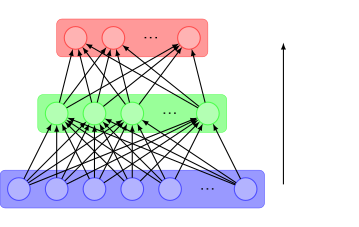
- perform forward pass and generate prediction
Recap: backpropagation algorithm in ffns
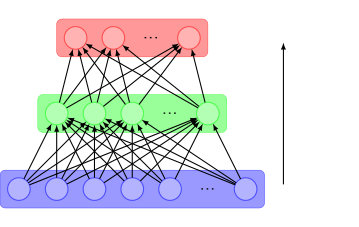
- perform forward pass and generate prediction
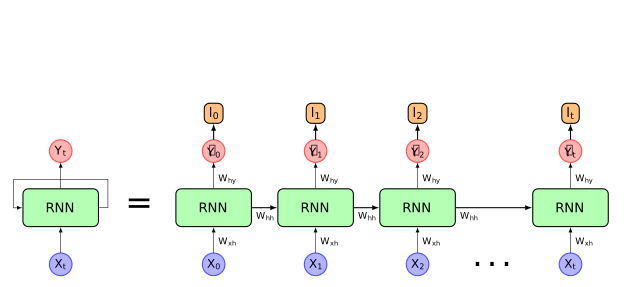
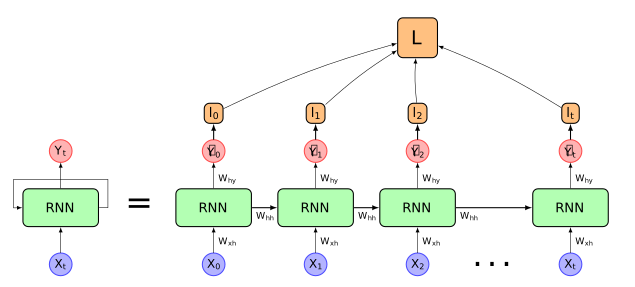
- calculate prediction error \epsilon_i wrt (known) output: \epsilon_i = \mathcal{L}(\hat{y}_i, y_i), loss function \mathcal{L}
Recap: backpropagation algorithm in ffns
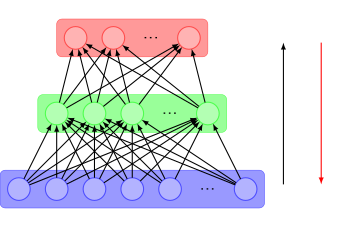
- perform forward pass and generate prediction
- calculate prediction error \epsilon_i wrt (known) output: \epsilon_i = \mathcal{L}(\hat{y}_i, y_i), loss function \mathcal{L}
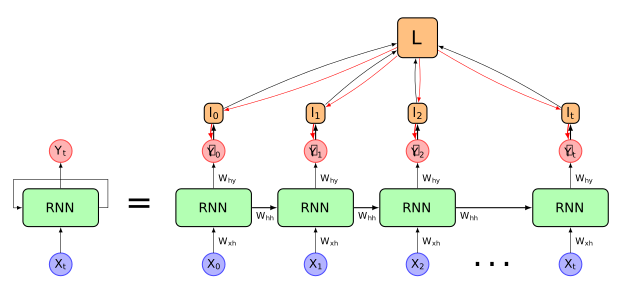
- backpropagate errors and update weights to minimize loss
Backpropagation through time (BPTT)
Backpropagation through time (BPTT)
Backpropagation through time (BPTT)
Backpropagation through time (BPTT)
Backpropagation through time (BPTT)
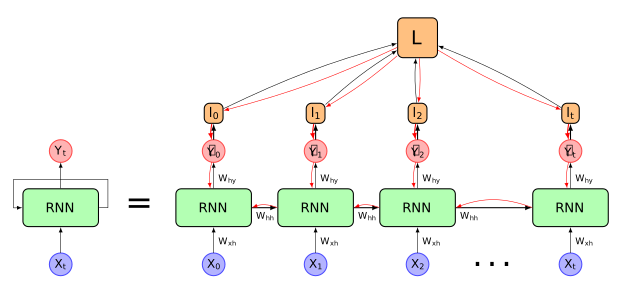
Backpropagation through time (BPTT)
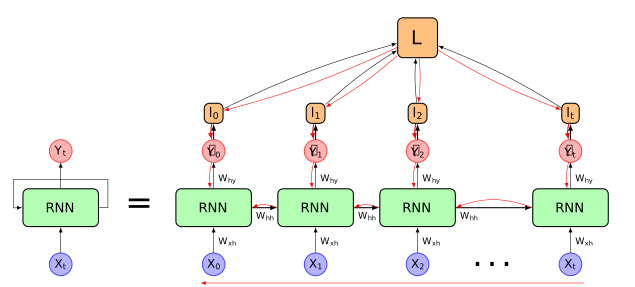
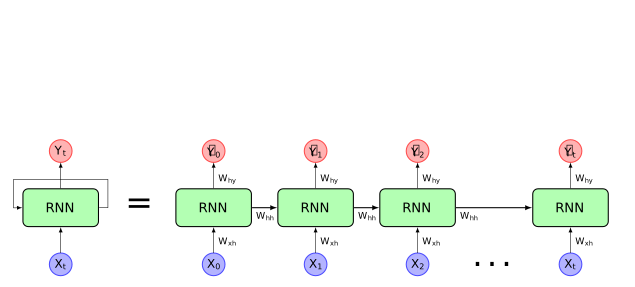
Errors are propagated backwards in time from t=t to t=0.
Problem: calculating gradient may depend on large powers of \mathbf{W_{hh}}^{\mathsf{T}} (e.g., \delta\mathcal{L} / \delta h_0 \sim f((\mathbf{W_{hh}}^{\mathsf{T}})^t)
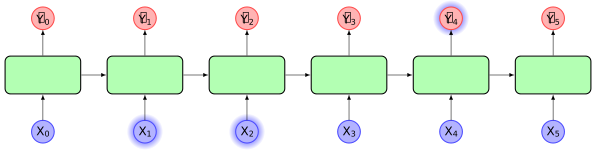
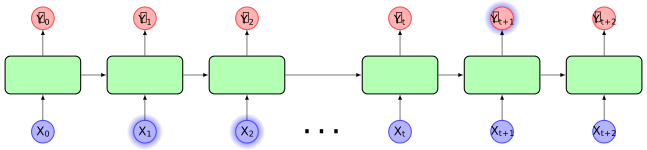
The effect of vanishing gradients on long-term memory
In layer i gradient size ~ (\mathbf{W_{hh}}^{\mathsf{T}})^{t-i}
\downarrow
Weight adjustments depend on size of gradient
\downarrow
Early layers tend to “see” small gradients and do very little updating
\downarrow
Bias parameters to learn recent events
\downarrow
RNN suffer short term memory
Solutions to vanishing gradient
1. Activation function
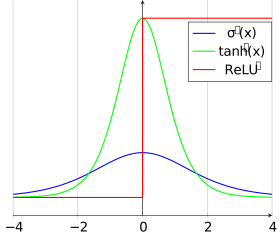
ReLU (or leaky ReLU) instead of sigmoid or tanh.
Prevents small gradient: for \mathbb{x>0}, gradient positive constant
Derivatives of \sigma, \mathsf{tanh} and \mathsf{ReLU} activation functions.
Solutions to vanishing gradient
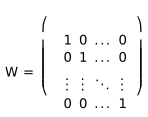
2. Weight initialization
Set bias=0, weights to identity matrix
Solutions to vanishing gradient
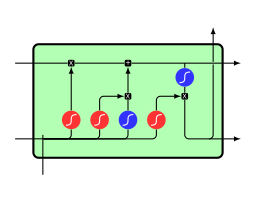
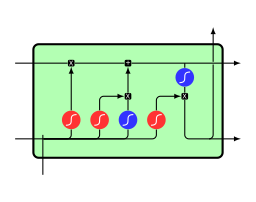
3. More complex cells using “gating”
For example LSTM. Idea is to control what information is retained within each RNN unit.
Make use of regular multiplication (x) and addition (+) to combine signals.
Motivation behind LSTMs and GRUs
LSTM
GRU
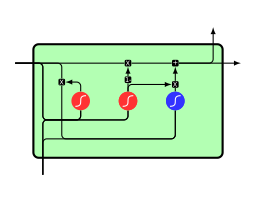

Long Short Term Memory (LSTM) (Hochreiter & Schmidhuber, 1997) and Gated Recurrent Unit (GRU) (Cho et al., 2014) architectures were proposed to solve the vanishing gradient problem.
LSTM: Cell state flow and gating
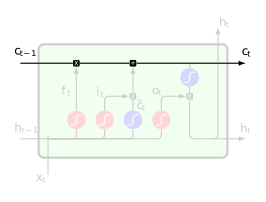
LSTM adds cell state that in effect provides the long-term memory
Information flows in the cell state from c_{t-1} to c_t.

Gates affect the amount of information let through. The sigmoid layer outputs anything from 0 (nothing) to 1 (everything).
In our preliminary experiments, we found that it is crucial to use this new unit with gating units. We were not able to get meaningful result with an oft-used tanh unit without any gating.
Forget, input, and output gates
forget gate
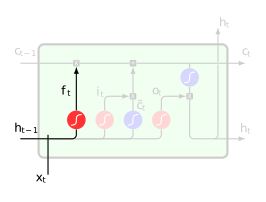
Purpose: reset content of cell state
input gate
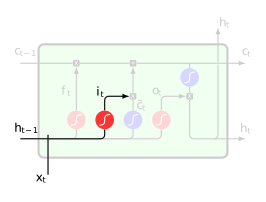
Purpose: decide when to read data into cell state
output gate
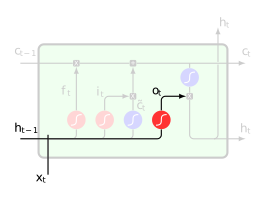
Purpose: read entries from cell state
Sigmoid squishes vector [\boldsymbol{h_{t-1}}, \boldsymbol{x_t}] (previous hidden state + input) to (0, 1) for each value in cell state c_{t-1}, where 0 means “reset entry”, 1 “keep it”
The forget gate
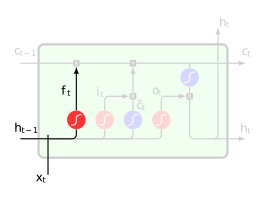
Purpose: decide what information to keep or throw away
Sigmoid squishes vector [\boldsymbol{h_{t-1}}, \boldsymbol{x_t}] (previous hidden state + input) to (0, 1) for each value in cell state c_{t-1}, where 0 means “forget entry”, 1 “keep it”
f_t = \sigma(W_f \cdot [h_{t-1}, x_t] + b_f)
Add new information - the input gate
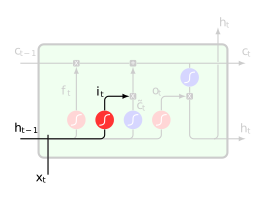
Two steps to adding new information:
- sigmoid layer decides which values to update
Add new information - get candidate values
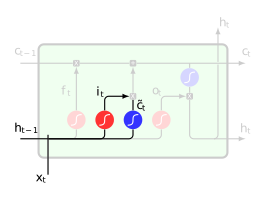
Two steps to adding new information:
- sigmoid layer decides which values to update
- tanh layer creates vector of new candidate values \tilde{c}_t
i_t = \sigma (W_i \cdot [h_{t-1}, x_t] + b_i)\\ \tilde{c}_t = \mathsf{tanh}(W_c \cdot [h_{t-1}, x_t] + b_c)
Updating the cell state
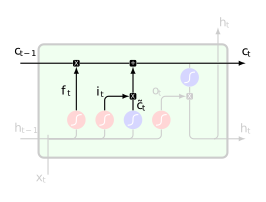
- multiply old cell state by f_t to forget what was decided to forget
- add new candidate values scaled by how much we want to update them i_t * \tilde{c}_t
c_t = f_t * c_{t-1} + i_t * \tilde{c}_t
Cell output
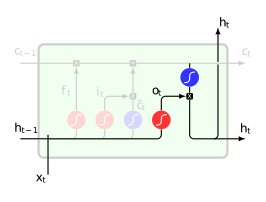
Output is filtered version of cell state.
- sigmoid output gate decides what parts of cell state to output
- push cell state through tanh and multiply by sigmoid output
o_t = \sigma(W_o [h_{t-1}, x_t] + b_o)\\ h_t = o_t * \mathsf{tanh}(c_t)
LSTM: putting it together
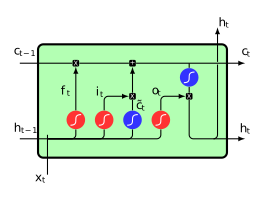
LSTM: putting it together
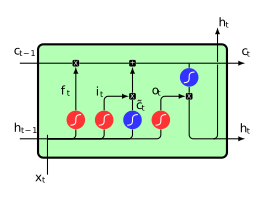
f_t = \sigma(W_f \cdot [h_{t-1}, x_t] + b_f)\\ i_t = \sigma (W_i \cdot [h_{t-1}, x_t] + b_i)\\ \tilde{c}_t = \mathsf{tanh}(W_c \cdot [h_{t-1}, x_t] + b_c)\\ c_t = f_t * c_{t-1} + i_t * \tilde{c}_t\\ o_t = \sigma(W_o [h_{t-1}, x_t] + b_o)\\ h_t = o_t * \mathsf{tanh}(c_t)
x_t \in \mathbb{R}^{n\times d}, h_{t-1} \in \mathbb{R}^{n \times h}, i_t \in \mathbb{R}^{n\times h}, f_t \in \mathbb{R}^{n\times h}, o_t \in \mathbb{R}^{n\times h}, \\ c_t \in \mathbb{R}^{n\times h}, b_i,b_f,b_c \in \mathbb{R}^{1\times h}
and
W_f \in \mathbb{R}^{n \times (h+d)}, W_i \in \mathbb{R}^{n \times (h+d)}, W_o \in \mathbb{R}^{n \times (h+d)}, W_c \in \mathbb{R}^{n \times (h+d)}
GRU
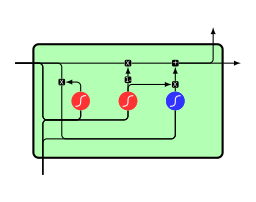
- forget and input states combined to single update gate
- merge cell and hidden state
- simpler model than LSTM
Example applications in genomics

Transformers
- process sequential input data (e.g., natural language)
- process entire input at once
- apply attention mechanism to provide positional context
Transformers were introduced in 2017 by a team at Google Brain and are increasingly the model of choice for NLP problems, replacing RNN models such as long short-term memory (LSTM). The additional training parallelization allows training on larger datasets
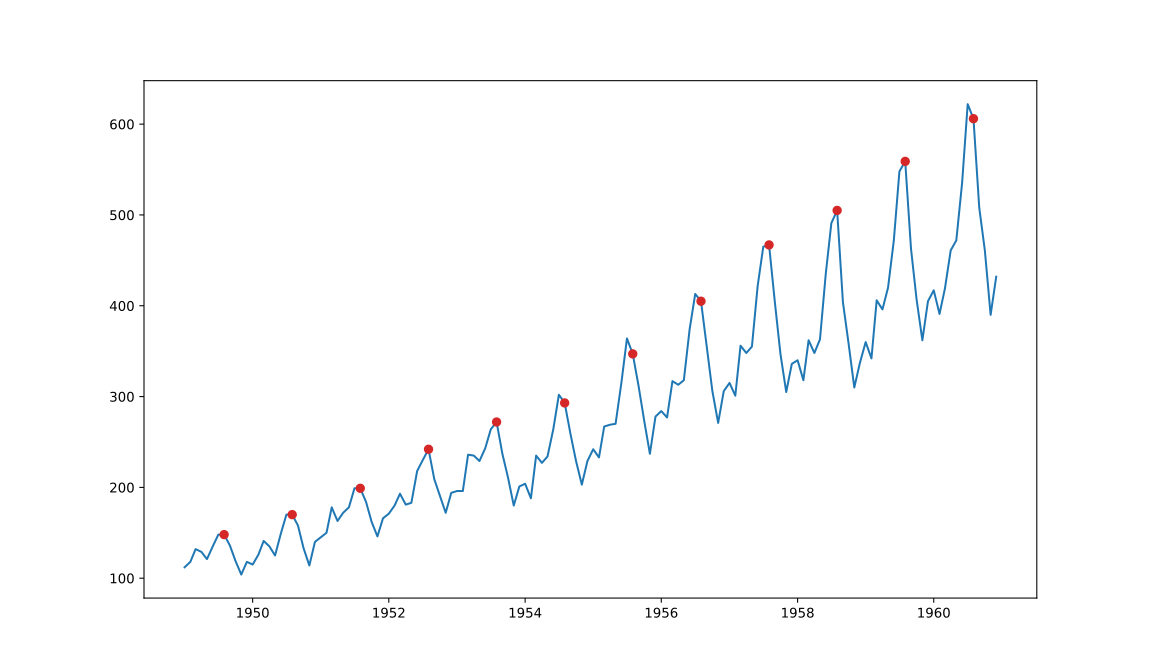
…the attention model can overcome […information loss…] by identifying important points in the time series to consider. All the points in the time series are assigned weights that are computed for each output time step. The more important points are assigned higher weights than the less important ones.
Hewamalage et al. (2021)
Bibliography
Adrion, Jeffrey R., Jared G. Galloway, and Andrew D. Kern. 2020. “Predicting the Landscape of Recombination Using Deep Learning.” Molecular Biology and Evolution 37 (6): 1790–808. https://doi.org/10.1093/molbev/msaa038.
Alexander Amini. 2021. MIT 6.S191: Recurrent Neural Networks. https://www.youtube.com/watch?v=qjrad0V0uJE.
Cho, Kyunghyun, Bart van Merrienboer, Caglar Gulcehre, et al. 2014. “Learning Phrase Representations Using RNN Encoder-Decoder for Statistical Machine Translation.” arXiv:1406.1078 [Cs, Stat], September. http://arxiv.org/abs/1406.1078.
Herzen, Julien, Francesco Lässig, Samuele Giuliano Piazzetta, et al. 2021. Darts: User-Friendly Modern Machine Learning for Time Series. https://arxiv.org/abs/2110.03224.
Hewamalage, Hansika, Christoph Bergmeir, and Kasun Bandara. 2021. “Recurrent Neural Networks for Time Series Forecasting: Current Status and Future Directions.” International Journal of Forecasting 37 (1): 388–427. https://doi.org/10.1016/j.ijforecast.2020.06.008.
Karpathy, Andrej. 2015. The Unreasonable Effectiveness of Recurrent Neural Networks. https://karpathy.github.io/2015/05/21/rnn-effectiveness/.
Korfmann, Kevin, Oscar E Gaggiotti, and Matteo Fumagalli. 2023. “Deep Learning in Population Genetics.” Genome Biology and Evolution 15 (2): evad008. https://doi.org/10.1093/gbe/evad008.
MacKay, David J. C. 2003. Information Theory, Inference and Learning Algorithms. Illustrated edition. Cambridge University Press.
Olah, Christopher. 2015. Understanding LSTM Networks – Colah’s Blog. http://colah.github.io/posts/2015-08-Understanding-LSTMs/.
Onnen, Heiko. 2021. “Temporal Loops: Intro to Recurrent Neural Networks for Time Series Forecasting in Python.” In Medium. https://towardsdatascience.com/temporal-loops-intro-to-recurrent-neural-networks-for-time-series-forecasting-in-python-b0398963dc1f.
Phi, Michael. 2020. “Illustrated Guide to Recurrent Neural Networks.” In Medium. https://towardsdatascience.com/illustrated-guide-to-recurrent-neural-networks-79e5eb8049c9.
Shen, Zhen, Wenzheng Bao, and De-Shuang Huang. 2018. “Recurrent Neural Network for Predicting Transcription Factor Binding Sites.” Scientific Reports 8 (1): 15270. https://doi.org/10.1038/s41598-018-33321-1.
“Transformer (Machine Learning Model).” 2023. Wikipedia, March. https://en.wikipedia.org/w/index.php?title=Transformer_(machine_learning_model)&oldid=1144198335.
Vaswani, Ashish, Noam Shazeer, Niki Parmar, et al. 2017. Attention Is All You Need. arXiv:1706.03762. arXiv. https://doi.org/10.48550/arXiv.1706.03762.
Verma, Shiva. 2021. “Understanding Input and Output Shapes in LSTM Keras.” In Medium. https://shiva-verma.medium.com/understanding-input-and-output-shape-in-lstm-keras-c501ee95c65e.
Zhang, Aston, Zachary C. Lipton, Mu Li, and Alexander J. Smola. 2021. “Dive into Deep Learning.” arXiv Preprint arXiv:2106.11342.